High-grade history.
Modern discovery.
Advancing a drill-ready silver project adjacent to the historic Walton Mine in Nova Scotia.
Testing a potential feeder system to one of Canada’s highest-grade silver occurrences.
HIGHLIGHTS
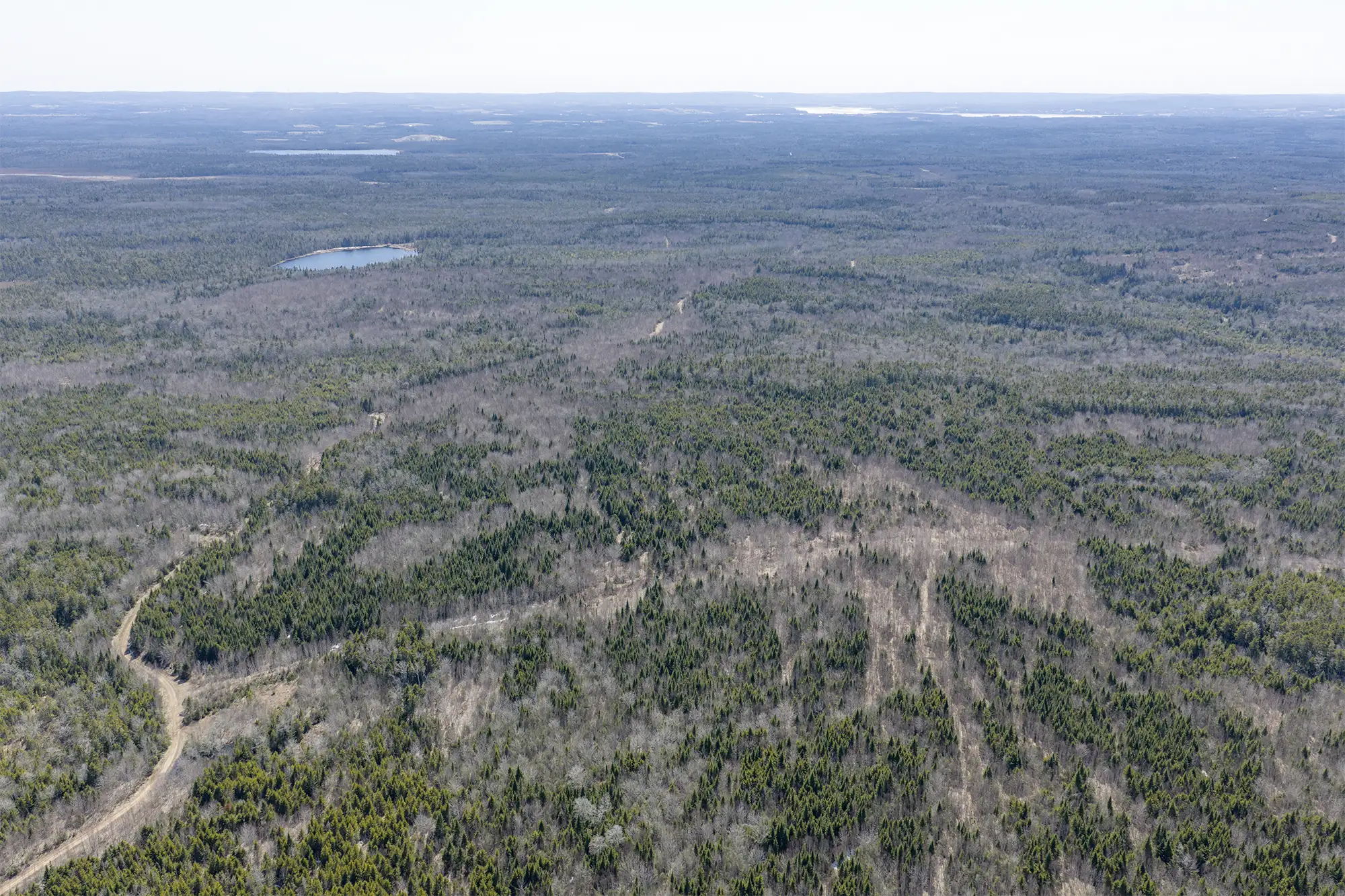
THE FOUNDATION
Consolidated land package (~1,100+ hectares)
.avif)
PROXIMITY
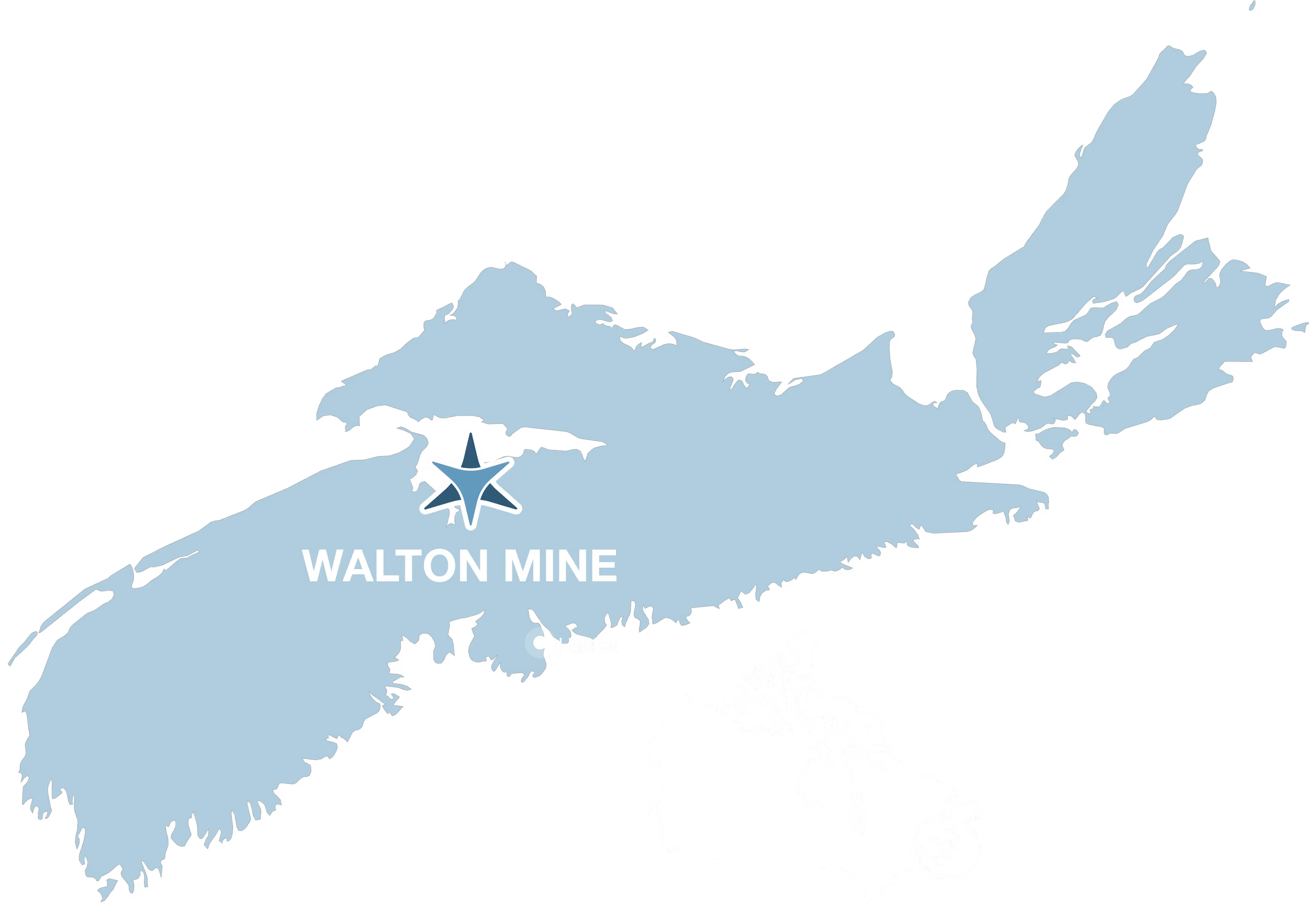
Located adjacent to the historic Walton Mine (historic grades up to ~5,754 g/t Ag)*
THE THESIS
Clear feeder system exploration thesis
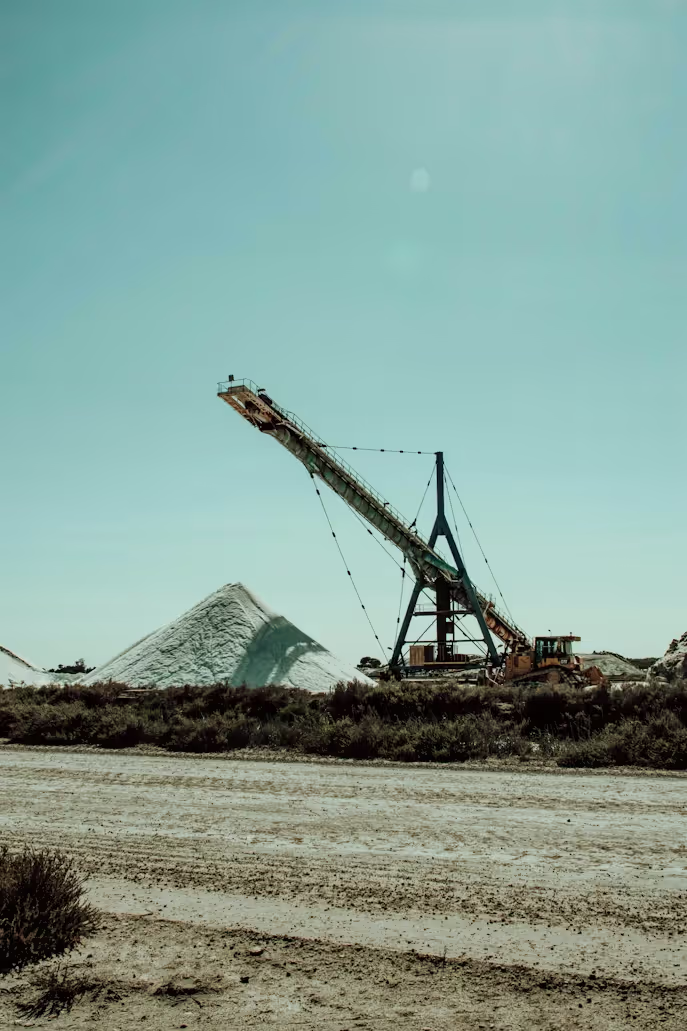
FULLY PERMITTED
Drill-ready with permits in place
.avif)
CLEAN ASSET
100% ownership with no underlying royalty burdens
STURGIS TARGET
The
Opportunity
TruSilver Metals Corp. is advancing the Sturgis–Walton Silver Project in Nova Scotia.
Modern geological and geophysical work indicates that the historic Walton Mine may represent only a small expression of a much larger mineralized system. TruSilver is focused on testing the potential feeder source of that system using a targeted and data-driven exploration approach.
Modern geological and geophysical work indicates that the historic Walton Mine may represent only a small expression of a much larger mineralized system. TruSilver is focused on testing the potential feeder source of that system using a targeted and data-driven exploration approach.
View Project
PROJECT SNAPSHOT
Nova Scotia, Canada
Location
Drill-ready
Stage
Carbonate Replacement Deposit (CRD)
Model
WHY NOW
Silver is increasingly important in electrification, renewable energy, and industrial applications. At the same time, global supply constraints are increasing the importance of new discoveries.
Silver is becoming a strategic metal for the AI, electrification and clean-energy economy. Silver has the highest electrical and thermal conductivity of any metal, making it difficult to replace in applications where efficiency, reliability and miniaturization matter. Oxford Economics, in research prepared for The Silver Institute, highlights silver’s expanding role across three major growth markets: data centres and artificial intelligence, electric vehicles and charging infrastructure, and solar photovoltaics. Solar alone has become a major demand centre, rising from 11% of silver industrial demand in 2014 to 29% in 2024, while electric vehicles are estimated to use 67%–79% more silver than internal combustion engine vehicles because of increased electronics, sensors, power systems and charging infrastructure. Oxford Economics also notes that global IT power capacity has increased 53-fold since 2000, underscoring the scale of computing infrastructure growth behind cloud computing, AI and data-centre expansion.
This demand growth is not simply cyclical — it is structural. A separate Oxford Economics report forecasts that silver industrial demand will increase 46% through 2033, led by the electrical and electronics sector, where output is expected to grow 55% over the decade. The Silver Institute also expects data centres, AI-related technologies and the automotive sector to continue supporting silver consumption across a range of industrial end uses, even as manufacturers attempt to reduce silver intensity in certain photovoltaic applications.
At the same time, the supply side remains constrained. The Silver Institute forecasts that the global silver market will remain in deficit for a sixth consecutive year in 2026, with total supply expected to rise only 1.5% to approximately 1.05 billion ounces, mine production increasing just 1% to 820 million ounces, and primary silver mines representing only 28% of mine supply. This matters because silver supply is relatively inelastic: much of global silver is produced as a by-product of lead, zinc, copper and gold mining, rather than from mines developed primarily for silver.
The long-term supply-demand picture may become even tighter. A 2026 peer-reviewed study in Resources, Conservation and Recycling forecasts that by 2030, global silver supply may meet only 62%–70% of projected demand, with total demand projected at 48,000–54,000 tonnes per year. The same study projects that solar could become the fastest-growing source of silver demand, reaching 10,000–14,000 tonnes per year, equal to approximately 29%–41% of projected supply, while competing sectors could still require an additional 38,000–40,000 tonnes per year. The study also notes that 72% of primary silver is produced as a co-product, making a rapid supply response by 2030 unlikely.
Together, these trends support a compelling investment thesis: silver is no longer only a precious metal or monetary hedge — it is increasingly a critical industrial input for the infrastructure behind AI, electrification, solar power and advanced electronics. As demand becomes more technology-driven and supply growth remains limited, high-quality silver exploration projects in stable jurisdictions may become increasingly strategic.
Footnote: Sources: Oxford Economics, Silver, The Next Generation Metal, prepared for The Silver Institute; Oxford Economics, Fabrication Demand Drivers for Silver Through 2033; The Silver Institute, 2026 Silver Market Outlook; Cattaneo et al., “Forecasting silver demand and supply by 2030: Impact of silver-intensive photovoltaic cells and sectoral competition,” Resources, Conservation and Recycling, Vol. 224, 2026.
This demand growth is not simply cyclical — it is structural. A separate Oxford Economics report forecasts that silver industrial demand will increase 46% through 2033, led by the electrical and electronics sector, where output is expected to grow 55% over the decade. The Silver Institute also expects data centres, AI-related technologies and the automotive sector to continue supporting silver consumption across a range of industrial end uses, even as manufacturers attempt to reduce silver intensity in certain photovoltaic applications.
At the same time, the supply side remains constrained. The Silver Institute forecasts that the global silver market will remain in deficit for a sixth consecutive year in 2026, with total supply expected to rise only 1.5% to approximately 1.05 billion ounces, mine production increasing just 1% to 820 million ounces, and primary silver mines representing only 28% of mine supply. This matters because silver supply is relatively inelastic: much of global silver is produced as a by-product of lead, zinc, copper and gold mining, rather than from mines developed primarily for silver.
The long-term supply-demand picture may become even tighter. A 2026 peer-reviewed study in Resources, Conservation and Recycling forecasts that by 2030, global silver supply may meet only 62%–70% of projected demand, with total demand projected at 48,000–54,000 tonnes per year. The same study projects that solar could become the fastest-growing source of silver demand, reaching 10,000–14,000 tonnes per year, equal to approximately 29%–41% of projected supply, while competing sectors could still require an additional 38,000–40,000 tonnes per year. The study also notes that 72% of primary silver is produced as a co-product, making a rapid supply response by 2030 unlikely.
Together, these trends support a compelling investment thesis: silver is no longer only a precious metal or monetary hedge — it is increasingly a critical industrial input for the infrastructure behind AI, electrification, solar power and advanced electronics. As demand becomes more technology-driven and supply growth remains limited, high-quality silver exploration projects in stable jurisdictions may become increasingly strategic.
Footnote: Sources: Oxford Economics, Silver, The Next Generation Metal, prepared for The Silver Institute; Oxford Economics, Fabrication Demand Drivers for Silver Through 2033; The Silver Institute, 2026 Silver Market Outlook; Cattaneo et al., “Forecasting silver demand and supply by 2030: Impact of silver-intensive photovoltaic cells and sectoral competition,” Resources, Conservation and Recycling, Vol. 224, 2026.

News
All News
Follow the Discovery
Join our list to receive Sturgis-Walton Silver Project results and more.
Oops! Something went wrong while submitting the form.